
Short answer: Synapses show how living systems can create complex patterns through many local interactions. They offer a useful way to think about networks, feedback, and emergence. That does not mean synapses literally contain universes, or that neuroscience has shown the physical universe to arise from brain activity. The connection is a question for careful exploration, not an established scientific conclusion.
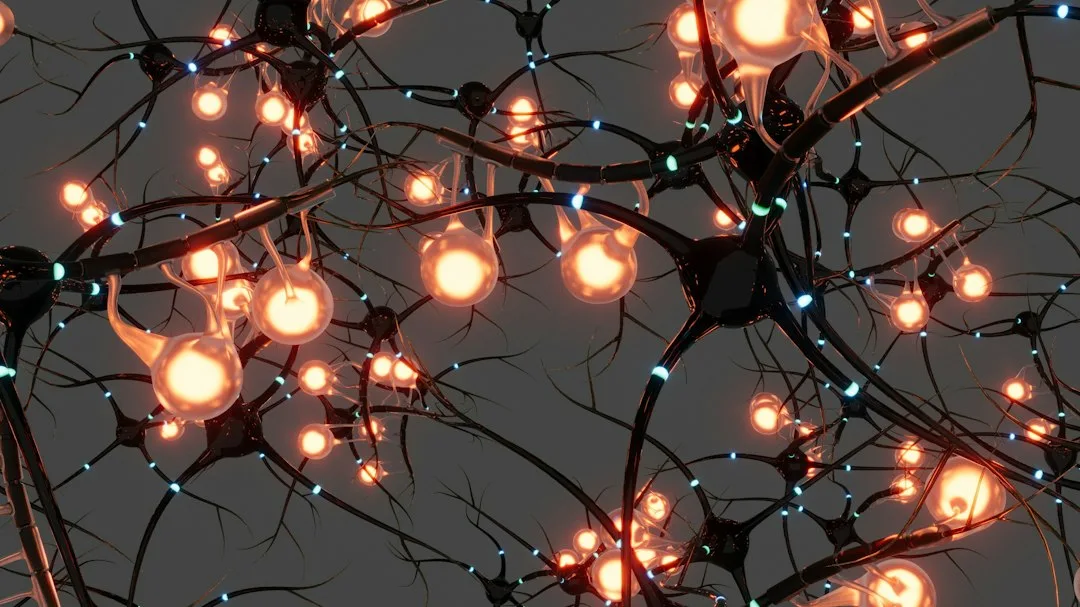
At SourceUnity, the question “What kinds of universes materialize through synaptic activity?” can be read in two ways. One asks how a brain builds the experienced world we live in. The other asks whether patterns in neural networks can help us think about complexity and the cosmos. These are related questions, but they are not the same claim.
Featured image: Bhautik Patel via Unsplash.
1. The synapse: a small connection with a larger role
A synapse is a specialized junction through which one neuron influences another cell. Many chemical synapses work by releasing neurotransmitters that bind to receptors on a receiving cell, changing its activity. Synapses can differ in strength and can change with experience. Networks of neurons combine these many signals into activity involved in sensation, movement, memory, attention, and other functions.
No single synapse explains a whole perception or memory. What matters is the organized activity of many neurons, their connections, the body’s signals, and the brain’s interaction with its environment. The larger pattern depends on relationships among parts.
For an accessible scientific foundation, see the National Institute of Neurological Disorders and Stroke’s Brain Basics and the National Library of Medicine’s Synaptic Transmission reference. These sources describe biology; the broader philosophical connections explored below are interpretations built from that foundation.
2. The experienced world is not a simple copy of the outside world
What we experience is shaped by incoming sensory signals, attention, memory, expectation, bodily state, and ongoing interpretation. The brain does not merely receive a finished picture and display it unchanged. It processes information, integrates signals, and helps guide perception and action.
This gives the first meaning of “a universe materializing through synaptic activity”: the lived world as experienced by a particular person. Each of us encounters a shared environment through a nervous system and a history that are never exactly the same as another person’s.
That does not mean the outside world is imaginary or that every perception is equally accurate. The world constrains what we can reliably perceive, and perception can be tested against evidence, other observers, and the consequences of action. Individual experience is constructed and interpreted without being detached from reality.
3. From neurons to networks: why relationships matter
Complex systems often display patterns that are difficult to predict by examining one part in isolation. In a neural network, a neuron’s effect depends on which cells it connects to, the strength and timing of those connections, the activity already present, and feedback across the network.
This is one reason synapses can inspire questions about emergence: how larger-scale patterns arise from many interacting components. The same broad question appears in ecology, weather, economies, and other networked systems. But each system has its own mechanisms. A resemblance in organization does not prove that the systems work in the same way.
Neural networks are biological systems shaped by evolution, chemistry, electrical activity, bodies, and environments. Cosmological structures arise through physical processes on vastly different scales. We can compare questions about relationship and complexity without treating a metaphor as a shared mechanism.
4. Could the universe itself be like a brain?
Images of cosmic filaments and neural networks can look strikingly similar. Visual similarity is a useful prompt for curiosity, but it is not enough to establish a scientific connection. To support a stronger claim, researchers would need precise definitions, measurable predictions, a plausible mechanism, and evidence that distinguishes the idea from coincidence or a superficial resemblance.
There is currently no established scientific evidence that the universe is literally a brain, that synapses generate physical universes, or that the cosmos and neural tissue share one underlying information-processing mechanism simply because some patterns look alike. Those are speculative interpretations, not conclusions of mainstream neuroscience or cosmology.
A more grounded question is: what general lessons can we learn by comparing complex systems? We can ask how local interactions create larger patterns, how feedback stabilizes or changes a system, and how scale affects what an observer can see. These are productive questions even when the systems are not identical.
5. Zoom in, zoom out
Zoom in and a synapse is a biological junction with specific chemical and electrical properties. Zoom out and synapses participate in neural circuits, which support cognition and behavior. Zoom out further and a person is embedded in relationships, culture, ecosystems, and the physical world.
Each scale reveals something different. No single scale tells the whole story, and moving between scales does not erase the differences between them. A useful explanation keeps both the details and the larger context in view.
This resonates with a recurring SourceUnity theme: the part and the whole are distinct ways of looking at a connected reality. That is a philosophical framing of the comparison, not a scientific law derived from synapses.
6. Where evidence ends and interpretation begins
- Established biology: Synapses transmit signals between cells, and synaptic changes contribute to learning and neural function.
- Supported general principle: Networks and complex systems can exhibit large-scale behavior shaped by interactions among their components.
- Useful analogy: Studying synapses can inspire questions about relationships, feedback, and patterns across scales.
- Speculation: Claims that synapses create physical universes or prove that the cosmos is a brain go beyond current evidence.
Keeping these distinctions visible does not diminish wonder. It protects curiosity from being mistaken for proof and makes it easier to discover what further evidence might actually show.
Questions worth carrying forward
- How do local interactions contribute to large-scale patterns in different kinds of systems?
- How does the nervous system combine sensation, memory, attention, and expectation into a coherent experience?
- Which similarities between neural and cosmic networks are measurable, and which are mainly visual or metaphorical?
- What evidence would be needed to move a proposed connection from analogy to a testable scientific hypothesis?
The value of the question may not be in forcing the brain and the universe into one explanation. It may be in learning to move between scales without losing the details, to notice patterns without assuming they prove sameness, and to let curiosity lead to better questions.
Explore the connections
- What Is Awareness?
- The Trinary Model of Continuous Consciousness
- What Is Interconnectedness?
- SourceUnity Core Concepts
- Explore the SourceUnity Topic Map
Zoom in for the mechanism. Zoom out for the relationships. Keep the difference between evidence and interpretation in view.